EXT4 vs XFS for Oracle, which one performs better?
[UPDATE] Since publishing this post I received requests to benchmark ASM and Oracle Enterprise Linux. An updated post for this article EXT4 vs XFS vs ASM vs ASM + OEL, which one performs better? Taking it to the next level.
My past few blog posts have all been on Oracle and SLOB (Silly Little Oracle Benchmark) create by Kevin Closson. As part of a number of runs with SLOB, I also was curious to benchmark EXT4 and XFS file systems.
EXT4 vs XFS, which file system performs better?
As you can imagine there is not a single and simple answer to these questions because it depends on a number of variables – so I tried to eliminate most of them.
- The same server
- The same VM configuration
- The same Hypervisor
- The same Oracle configuration
- The same SLOB configuration (30min with a 70:30 Read/Write ratio)
- The same LVM configuration
- The same storage configuration (I am using Datrium DVX, which uses localhost SSDs to perpetually read data I/O locally at bus speeds. More info on the exact config here)
The only aspect changing between tests is the datadisk filesystem, being either EXT4 or XFS. Here is an image of the disk configuration.
–CentOS/7 (XFS)
|–250 GB
–Oracle U01 (XFS)
|-250 GB
–Oracle U02 (XFS)
|–250 GB
–Oracle Datadisk (LVM)
|-500 GB
|-500 GB
|-500 GB
|-500 GB
|-500 GB
|-500 GB
|-500 GB
|-500 GB
Additionally, considering that file systems can be optimized in countless ways I have accepted all the default configurations for
--- Volume group ---
   VG Name               vg-01
   System ID
   Format                lvm2
   Metadata Areas        8
   Metadata Sequence No  2
   VG Access             read/write
   VG Status             resizable
   MAX LV                0
   Cur LV                1
   Open LV               1
   Max PV                0
   Cur PV                8
   Act PV                8
   VG Size               <3.91 TiB
   PE Size               4.00 MiB
   Total PE              1023992
   Alloc PE / Size       1023992 / <3.91 TiB
   Free  PE / Size       0 / 0
   VG UUID               fC2LdY-IBs9-AfKd-LevI-WbfX-2PCx-VxSZei
--- Logical volume ---
   LV Path                /dev/vg-01/oracle
   LV Name                oracle
   VG Name                vg-01
   LV UUID                o3V0Ca-Qiv0-3tDI-bWsp-2mrA-Btci-zbckEu
   LV Write Access        read/write
   LV Creation host, time oradb02.slab.datrium.com, 2019-01-30 17:53:44 -0800
   LV Status              available
   # open                 1
   LV Size                <3.91 TiB
   Current LE             1023992
   Segments               1
   Allocation             inherit
   Read ahead sectors     auto
 currently set to     16384
 Block device           253:3
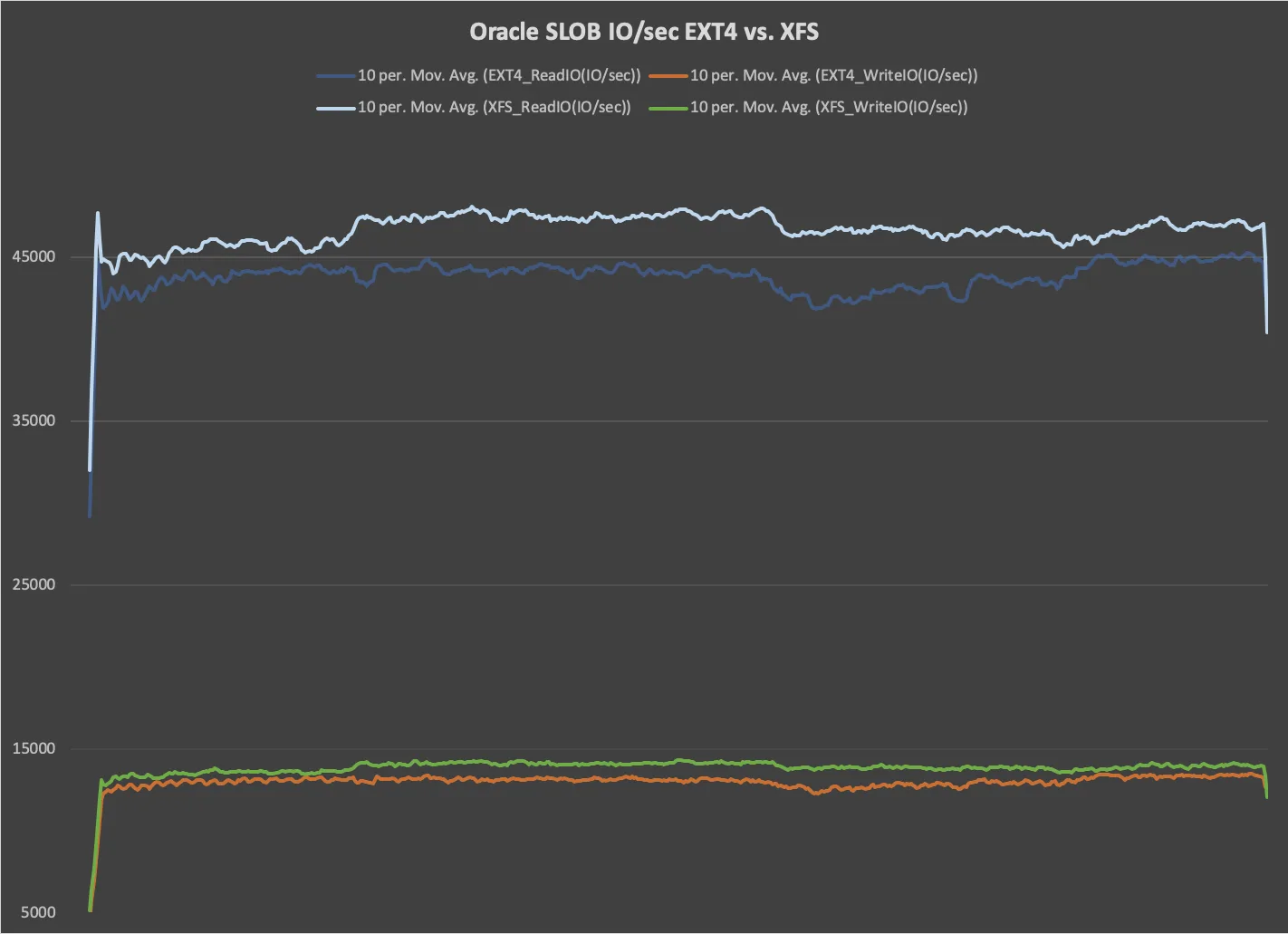
To collect the data I used Chris Buckel article on SLOB Sustained Throughput Test: Interpreting SLOB Results, and I graphed the same way.
However, looking at every data point in a graph doesn't really give us a solid understanding of what is happening because the SLOB workload is dynamic and there are peaks and deeps during a 30 minutes run.
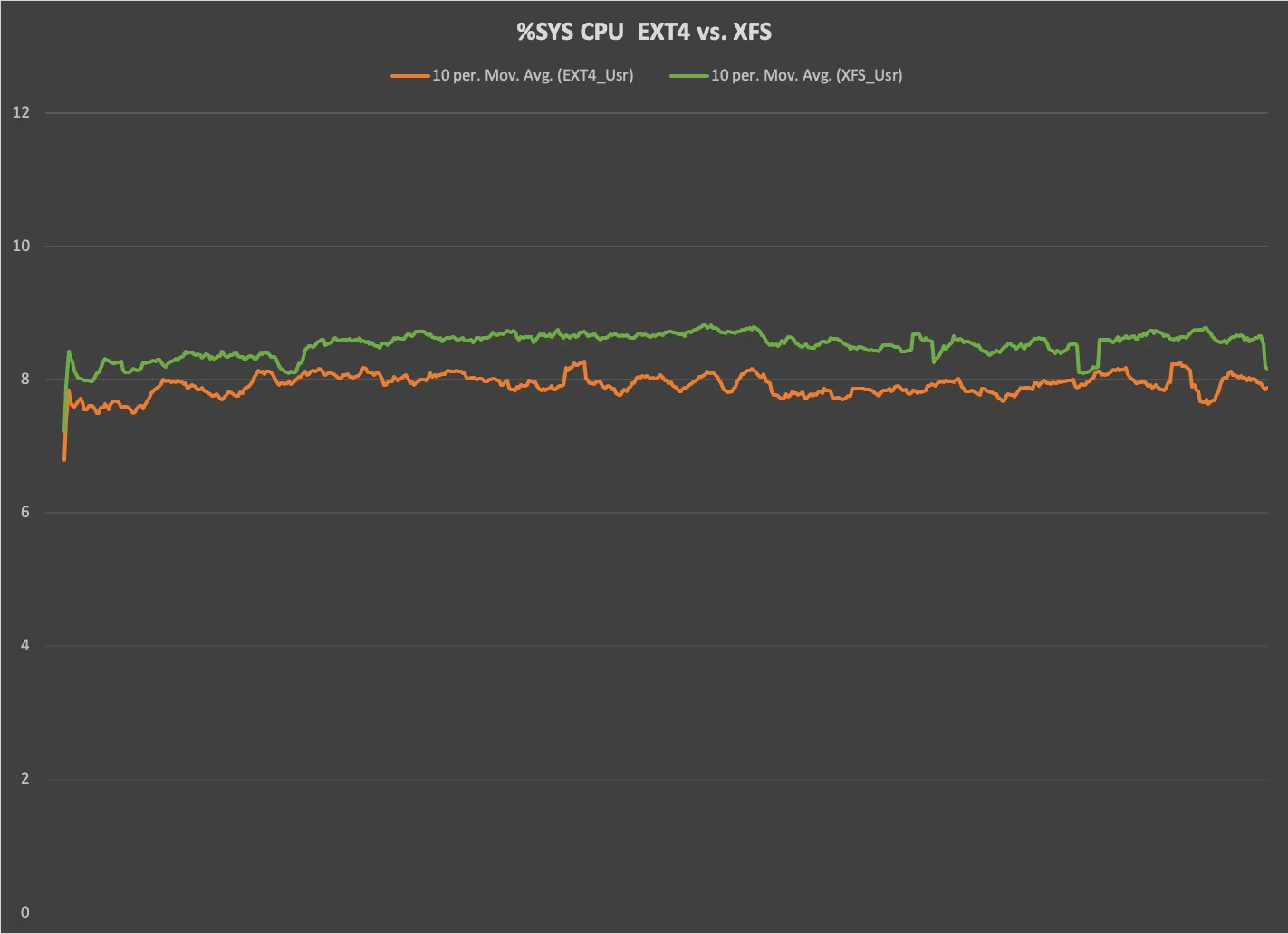
To eliminate outliers I replaced the time series with a trendline that uses a moving average of 10 data points (there are roughly 605 data points for each SLOB run). This approach removed anomalies while maintaining data fidelity.
Conclusion
The conclusion for this Oracle SLOB test that uses 8Kb block size I/O is that XFS performs better than EXT4 under the exact same default configuration conditions - further, XFS is able to better utilize the CPU available to drive performance, due to the parallel I/O based on allocation groups. As always, your mileage may vary :-)
6 comments
Lasse
Thanks for taking the time to test this, it's something I find rather interesting. Now, I am wondering why you chose CentOS and not RHEL or even better Oracle Linux w. UEKR5 ? A significantly newer kernel could have produced different results, also while the results are interesting I don't know of anyone who runs Oracle DB on CentOS as it's not supported in production.
Andre Leibovici
Hi Lasse, looks like I owe ourselves the same benchmark on Oracle Linux; which is the same distro with few add-on packages in my understanding. Should not be too hard to pull it off. I personally don’t believe there’ll be any meaningful change to the results, but I could be wrong.
https://linux.oracle.com/switch/centos/
Marco Patzwahl
I also use Centos for more then 10 years, and Never Had a Problem cause of the Not Supportet OS.
Lasse
Hi Andre,
If you use the same 3.10.x kernel then I wouldn't expect any significant differencies, however if you use Oracle's UEKR5 kernel then there might be a difference as it's a MUCH newer 4.14.x kernel.
Vince
–Oracle U01 (XFS)
|-250 GB
–Oracle U02 (XFS)
|–250 GB
–Oracle Datadisk (LVM)
If I'm understanding this, the database is on Oracle Datadisk which is either ext4 or xfs per test. But what's on U01 and U02. I have some guesses, but I'd rather you just clarify.
John
How to avoid Linux Filesystem cache effects?
Comments are preserved from the original site and are closed.