Datrium Scalability - Up to 138 Nodes
When you are a unique player your technology can be misunderstood and competitors can misguide customers. I recently came across a piece of competitive collateral from a HCI vendor with a slew of incorrect information about Datrium.
The first topic I covered was "Unique and Original Datrium Data Locality for Customers, Partners, and Competitors", but now I would like to talk about Datrium scalability.
Datrium employs a disaggregated architecture where computer nodes operate independently from datanodes. Compute nodes have local Flash devices for inherent data-locality, keeping the data that belongs to that node always local to the node, while datanodes work as a JBOD preserving the authoritative and deduplicated copy of the data.
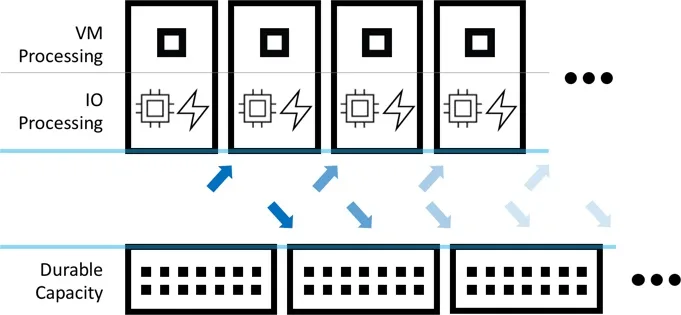
The maximum cluster size for the compute layer is 128 nodes, and the maximum cluster size for the storage layer is 10 datanodes.
Going from 1 to 128 compute nodes, for each added node the system is getting additional CPU and additional storage Read performance via the local Flash. Going from 1 to 10 data nodes, for each added datanode the system is getting additional storage capacity and additional write throughput. The minimum config is 1 compute node and 1 datanode, but from there it is possible to scale in any direction and in with granular increments.
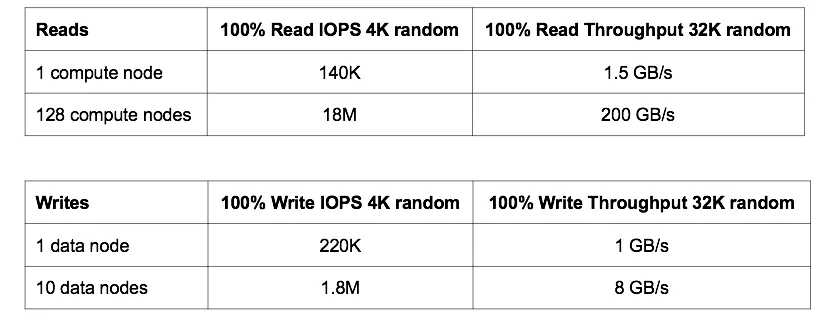
When populated with 128 compute nodes and 10 datanodes, the system will deliver 1.7 Petabytes of usable storage capacity, 18 Million Read IOPs and 256 GB/s of random write throughput. I wrote about the testing we have done in partnership with Dell, Intel and IOMark (here).
Conclusion
I hope this was a valuable way to understand the benefits of Datrium disaggregated architecture and independent scalability. In terms total number of nodes in a Datrium DVX, the number is 138, being 128 compute nodes and 10 datanodes.
Vendor competition is good and healthy for both, the customers and the industry, but misleading customers is not good. Competitors, please update your battle cards!